
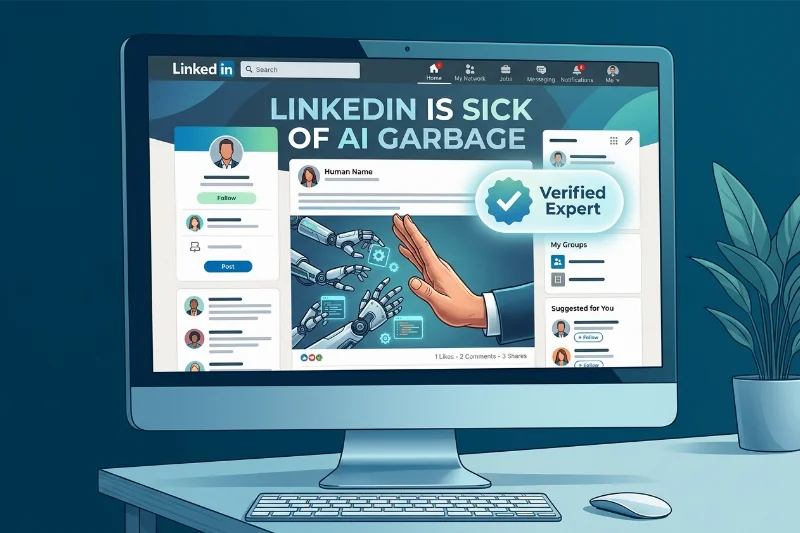
If you have spent more than five minutes on LinkedIn recently, you have likely felt the digital equivalent of a migraine. The feed, once a bastion of professional networking and genuine industry insight, has been overtaken by a relentless tide of \”thought leadership\” that feels suspiciously like it was written by a machine. From the overly structured lists to the oddly enthusiastic emojis, the platform is drowning in AI-generated fluff that says a lot while communicating absolutely nothing.
The Algorithmic Pivot Against Automation
LinkedIn has finally had enough. The platform is currently recalibrating its internal algorithms to deprioritize what many are calling \”AI slop.\” This shift isn’t just about identifying machine-generated text; it is about rewarding \”knowledge and advice\” that stems from lived experience. If your post looks like a prompt result from a basic LLM, the algorithm is increasingly likely to bury it under a mountain of more authentic content.
The Death of the Generic Listicle
We have all seen them: the \”10 ways to revolutionize your workflow\” posts that offer zero specific examples or unique data points. These generic listicles are the first casualties of LinkedIn’s new quality standards. When everyone uses the same tools to generate the same advice, the value of that advice drops to zero. Users are scrolling past these posts with aggressive indifference, and the platform’s engagement metrics are reflecting this fatigue.
Why Human Nuance Is the New Gold
Authenticity is no longer a buzzword; it is a survival tactic. In an era where a bot can write a five-hundred-word article in three seconds, the only thing that retains value is the human perspective that a bot cannot replicate. This means sharing failures, specific case studies, and contrarian opinions that haven’t been sanitized by a Large Language Model. LinkedIn’s leadership has signaled that they want to see \”unique perspectives\” that help members grow professionally.
Furthermore, the \”collaborative articles\” feature, which was initially criticized as an AI playground, is being refined. The platform is now emphasizing the contributions of \”Top Voices\” who add specific, nuanced commentary rather than those who simply summarize the AI’s initial prompt. This is a clear signal: if you aren’t adding value, you are just adding noise, and the noise-canceling headphones are coming on.
Reclaiming Your Personal Brand
Your personal brand is a fragile thing, built on trust and perceived expertise. When you outsource your voice to an AI without heavy editing and personalization, you are effectively telling your network that you don’t have an original thought. This \”AI garbage\” doesn’t just annoy your followers; it actively erodes your professional credibility. People connect with people, not with polished algorithms that mimic human warmth.
To fix your strategy, treat AI as a research assistant or a structural framework rather than a ghostwriter. Use it to brainstorm ideas or summarize long reports, but when it comes time to hit the \”Post\” button, ensure the voice is unmistakably yours. Inject your own anecdotes, your specific industry jargon, and your personal tone. If you can’t tell you wrote it, your audience certainly won’t be able to either.
Conclusion: The Future Is Personal
LinkedIn’s crackdown on AI-generated garbage is a net positive for the professional community. It forces us to return to the core of what networking is: sharing value and building relationships. By moving away from automated quantity and returning to human quality, we can restore the feed to a place of genuine learning. Stop posing with AI-generated fluff and start showing up as your authentic, messy, and brilliant self.